Russell Dickerson at Heart 360 Concert - November 13th

Russell Dickerson at Heart 360 Concert - November 13th

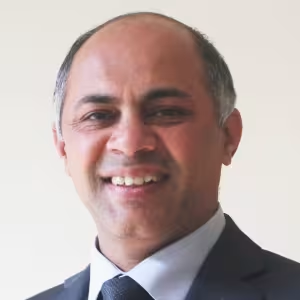
Dr. Vinnie Bapat joined the Valve Science Center team in June 2020, bringing extensive expertise as a cardiothoracic surgeon and innovator in the treatment of heart valve disease. In recognition of his internationally renowned research and educational work in valvular heart disease, he was named the James R. and Judith A. Bradshaw Chair for the Valve Science Center in 2026. Dr. Bapat also serves as chair of cardiothoracic surgery at Allina Health Minneapolis Heart Institute, where he cares for patients directly.
Before joining the team, Dr. Bapat was a cardiac surgeon at NewYork-Presbyterian Hospital and a professor of cardiothoracic surgery at Columbia University Medical Center in New York. He previously served as a professor of cardiothoracic surgery at Guy’s and St Thomas’ Hospital in London and continues to hold that position as a visiting professor.
Dr. Bapat earned his Bachelor of Medicine and Bachelor of Surgery degrees, followed by Master of Surgery and Master of Cardiothoracic Surgery degrees, at the University of Bombay in India and King Edward Memorial Hospital. He completed his Fellowship of the Royal Colleges of Surgeons (FRCS) in cardiothoracic surgery at the Royal College of Surgeons of Edinburgh in the United Kingdom. He also completed an internship, three residencies and two fellowships at institutions including King Edward Memorial Hospital and the University of Mumbai; Toronto General Hospital in Canada; and through rotations at Guy’s and St Thomas’ NHS Foundation Trust, King’s College Hospital NHS Foundation Trust and Royal Sussex County Hospital in Brighton, United Kingdom.
In addition to his clinical accomplishments, Dr. Bapat has been a collaborator among his peers in transcatheter valve therapy through the creation of two mobile apps: Valve-in-Valve (VIV) Mitral and VIV Aortic. The apps provide imaging and clinical information, including dimensions and characteristics of various valve repair technologies, and have been downloaded in more than 130 countries. Through these tools, physicians can access data and clinical insights to determine technology options based on individual patient needs, including guidance on implant procedures. The apps are free to download and are updated annually to provide current guidance.